
Heated Rivalry II
0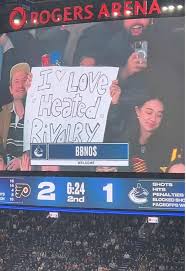 By Harbour Heather
As an ice hockey fan, the response to Heated Rivalry has been a fascinating watch. Important to note here from the top that I’m a straight, cis-gender woman, so the true impact on the queer community isn’t something I’m well-placed to touch on. My observations here are more about how this “gay hockey show” has hit the NHL.
The algorithms nailed their targeting of me, and as an avid reader, I sped through the two books in the Game Changers series which are tied to the show’s focus couple (Heated Rivalry and The Long Game) before the show started.
I immediately thought “Ready or not, hockey, you’re about to get a whole lot of new eyes on you.”
Hockey is not the first sport to gain attention from a pop culture moment, most recently seen in the NFL with the Taylor Swift effect. A quick snapshot of just some of the data: Heated Rivalry had over 300 million minutes of streaming time by the end of December, averaging 8 million viewers per episode in the US alone. Since its premiere, hockey ticket sales on SeatGeek are up 20%, while StubHub reported a 75% increase in searches for hockey tickets.
The NHL’s relationship with the queer community is a complicated one, something I’ve addressed before. “Hockey is for everyone” is an idealistic tagline used by the League to encourage diversity in all its forms, but it’s also a great ‘rainbow-washing’ statement. Growing momentum throughout the 2010s, Pride nights were introduced across the league featuring special jerseys, the Stanley Cup was part of the Chicago Pride Parade, and players started using rainbow stick tape to show their support.
But in 2023, there was a shift, perhaps following America’s return to conservative politics. Some players pushed back for religious reasons, some Russian players did too, saying they could face consequences for supporting Pride initiatives when they return home, given the country’s archaic view on homosexuality. It got to a point where the League put a ban on any type of ‘special’ jersey, including military and indigenous jerseys. Clubs could still host themed nights, have special merchandise, paint their rinks in rainbow colours, but the players were not to be involved.
Since then, things have cooled a little, and Pride Nights and Pride Tape have made their way back. Many players remained vocal allies. But in no way was the NHL ready for this influx of new eyes, many from within the queer community.
For a while, the League itself didn’t have anything to say about the show, but some of the teams weren’t going to let the moment pass. The Montreal Canadiens were the first to get involved, hosting some of the actors and playing the trailer during a game within a week of the show’s release. As the Heated Rivalry snowball kept getting bigger, arenas across the League played songs from the show, a wink that yes, teams knew about it, and were in on the hype.
Last week, NHL Commissioner Gary Bettman finally addressed the show. It took a month after the final episode dropped (and we all went to the cottage) before the head of the League commented on a massive cultural phenomenon in his sport (see Kiwi Kali’s post here to outline the mainstream impact the show has had). Oh to have been a fly on the wall in the round table discussions of “if/how do we acknowledge this?” In the end, he said he binged all six episodes in one night, and that the League had “meaningfully embraced” the LGBTQ+ community.
But… with Brock McGillis only feeling comfortable to come out following his retirement, and Luke Prokop yet to make his NHL debut, it appears that playing in the NHL isn’t “for everyone”. The show has inspired former players from other professional leagues to come out, but like many men’s sports, there is still that elusive golden goose of an out active player in the best league in the world. With over 700 players active on rosters across 32 teams, the odds are there’s a smattering of gay or bisexual players in the League.
But the League isn’t ready for them. Contrast this to the PWHL, where there are many queer players, including couples across and within teams (you can watch the Canadian GOAT Marie-Philip Poulin and her wife Laura Stacey at the upcoming Winter Olympics). Women’s sport has always been a safer place for people who are not straight, and men’s sport has been the opposite. Hypermasculinity pushes out anyone who doesn’t fit the perceived mold, or forces males to hide who they are for fear of rejection. This topic is broached in The Long Game, which Season 2 of Heated Rivalry will adapt, but the show is unlikely to cause the massive cultural change required in its structures to encourage players coming out.
From the fan perspective, the NHL is so far and away fourth of the four “main” sporting leagues in North America, so any cut through they can get from the zeitgeist should be welcomed with open arms. The League has acknowledged the show is “a unique driver” of new fans – there’s a real, growing group of people swooning over fictional hockey players, and you have the potential to convert them into lifelong lovers (“No Ilya, that’s gross”) of the game.
Whether their interest is surface level, based on team names or colours, or if they end up being able to debate the merits of playing seven defensemen, is that not a great result? More people watching your sport is win-win, but you need to walk the walk or token gestures will push them away. Don’t just take their money. That’s the challenge for the NHL.
To be in a position where a show about queer hockey players has enough cultural capital that real life players are being asked about it shows how far we’ve come around normalising queer discussions. What shows how far we have to go is the scary, lawless land of social media. It’s not just the way other players would react, but how general society would respond too. In our modern age, you would be naïve to think a player in the League could come out and not get attention, and I imagine the player and their support team would know that. What they can’t predict or control in any way is how the internet would react – insecure “stick to sports” homophobia and creepy parasocial fantasies are both already present in response to a fictional television show. A closeted player could be forgiven of seeing that and saying ‘no way, what would they do with me?’
It seems the League was surprised by Heated Rivalry. With the show confirmed for two more seasons, they now have time to react and demonstrate how they welcome and support not only queer fans, but queer players, genuinely and authentically. The next book in the series lines the League up as a villain, so time to get ahead of it and prove that “hockey is for everyone” isn’t just real in fiction.
Kiwis can watch Heated Rivalry on NEON.
Follow Heather on Twitter