
The Story of a Game
2By Giovanni Tiso
Republished from four years ago
The fifth of July, 1982 was a Monday, and I was staying at my grandmother’s, in the countryside village of Villa Poma, for the early part of my Summer holiday break. My grandfather had died two years earlier and at around the same time a number of my local best friends moved, or were in the process of outgrowing my company. I had always been the youngest in the group, but suddenly I found myself on the wrong side of puberty; mostly gone were our group escapades, and completely gone were the night-time football games in the street in front of Nonna’s house, with a lamp-post and the bin for the recycled glass marking the only goal. And so I either went on solitary cycling excursions, often as far as Magnacavallo – a twelve kilometre round trip, past the railway tracks – or stayed indoors with Nonna, away from the fierce daytime heat. I would read or play while she busied herself around the house: it’s only some time later that I worked out that she was worried that people passing in front of our windows might see her idle, which – her socialist upbringing notwithstanding – she considered improper for a woman, even if the woman in question happened to be a widow well into her seventies. Occasionally I was able to convince her to hand my arse to me at briscola, which she did with scarcely contained glee, but the days were long.
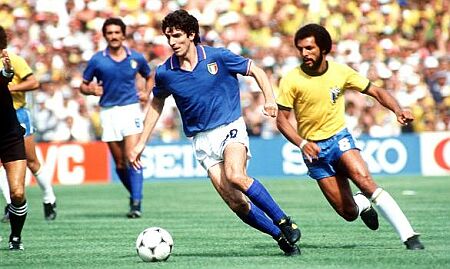
The fifth of July, 1982 was a very hot day in Villa Poma as it was in Barcelona. We played Brazil in the late afternoon, at the small stadium known as the Sarriá, and the players were already drenched in sweat before the game even started.
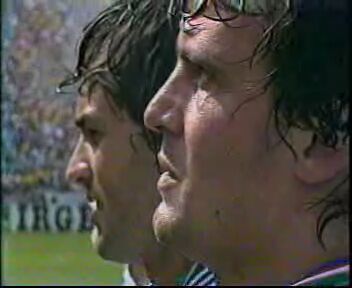
Marco Tardelli and Antonio Cabrini, who had the very sweet habit of holding hands during the anthem
Our players, that is: did the Brazilians even feel the heat? Did they sweat? You couldn’t be sure. What they did around the park hardly looked like effort – not for nothing they called it futbol bailado, a dance. A competitive dance, insofar as they still played to win, but the winning was a formality. They had only got into a spot of trouble in the opening game, against the Soviet Union, when their goalkeeper spilled an easy shot from long range, but they came back to win that one too, seemingly waiting until the last minute just so they could seal it with the perfect goal. The rest of their progress, including a conservative 4-0 tally against New Zealand, had been effortless, and effortlessly they dispensed of the hated Argentineans in the first game of the second round.
Cerezo, Falcão, Eder, Socrates, Zico: you will not find a better midfield in the annals of football. And if they always seemed fresher and faster and stronger it’s also because they let the ball do the much of the running, with sublime passes that looked, yes, as if they had been choreographed in advance.
On the fifth of July, 1982 I turned the television on at ten minutes past five and there they stood, lined up for the national anthems, looking like Martians. They had the superior song, the better looks, the greater confidence: in a game that they played for beauty, they won on aesthetic grounds alone, before the ball was even kicked.

Has there ever been a footballer more handsome than the statuesque Socrates (first from the right)?
Italy, on the other hand, was a shambles. A pallid copy of the exciting young team that had been the revelation of the 1978 tournament, where it placed fourth, it was a lacklustre group, unable to muster a single victory in the first round before finally finding enough vim to beat Argentina 2-1 in the second. Too little, too late, surely, to so much as bother Brazil, which thanks to its superior goal difference only needed a draw to advance to the semi-final. Not that it would matter to them, you suspected.
The Azzurri also carried extra ballast in Paolo Rossi, the striker whom coach Bearzot had taken on the expedition at the end of a long suspension for match-fixing, and who despite starting each and every game thus far had been totally, irritatingly ineffective, having developed an uncanny knack for finding himself in the wrong spot or mistiming the ball. And so it was that four minutes into the game he received an inviting cross from Tardelli that he intended to volley, but the ball spluttered perhaps one metre away, to the nearest golden shirt. It was going to be a long afternoon.
On the counter, Brazil looked like it was just getting comfortable. A probing ball for Serginho was cleared by Conti, Collovati stopped it from crossing the line for a corner kick and passed it to Scirea. He was our fullback, the libero, and the ball invariably went through him whenever we started a play from defence. (A very classy player and person, he died tragically in 1989 in a car crash in Poland, while scouting players for his old club.) On this occasion he served the ball up to Conti, who after a one-two with Oriali took it into the Brazilian midfield, eluded Cerezo, dribbled Eder – who briefly considered giving chase, but didn’t – then found Cabrini on the opposite wing with a long aerial pass. Cabrini took two steps and crossed the ball into the box where Rossi glided in behind a pair of defenders and headed it into the net.
Wait, what? Did we just score? Was it Rossi, of all people? We might be able to salvage some dignity after all. Make the Brazilians sweat a little. Or perhaps it will just make them angry. Watch out.
Looking at the play now – thirty-five seconds of uninterrupted Italian possession, from one end of the park to the other, without much in the way of pressure on the ball carrier – one is struck by how much football has changed in terms of style and pace. It was handsomely done, anyhow. Observe.
(And whilst we’re on the subject of differences, you’ll note the single commentator, and even if you don’t speak Italian you might work out that he’s simply calling the play – not much in the way of the so-called ‘colour’. No fancy camera angles or swooping aerial shots, either: an old-fashioned array of fixed cameras, and reverse angles for the replays, with little or no added graphic. It may be because I grew up with it, but to this day I find this style highly satisfying.)
Back at the Sarriá, there was barely time to brace for the inevitable Brazilian onslaught that they had already drawn level: after Serginho missed a fortuitous chance alone in front of Dino Zoff, the Italian keeper, Zico sent Socrates galloping into the box with a beautifully angled through-ball, and the tall, bearded one finished it with a searing shot between Zoff and the post.
The balance had been swiftly restored, but it would be disrupted again ten minutes later. Perhaps unaccustomed to being pressured in their own half, the Brazilians tried to clear the ball laterally instead of sending it downfield, allowing Rossi to intercept the pass and beat Valdir Peres from just outside the box. A less handsomely crafted goal than either of the ones that preceded it, but we’d take it.
Belief began to creep in, not just in Barcelona, but in Villa Poma as well. If only we could hold them off until the break. If we could keep spending time in their half. If Gentile could neutralise Zico like he had Maradona in the previous match. If Zoff played the game of his already long and illustrious career. Nonna kept pottering while I started to timidly entertain these thoughts, and we did indeed reach the break with little more flutter to register than an imperious header by Socrates blocked with poise by Zoff.
Early in the second half, more topsy-turvyness: it was the Brazilian midfield who enjoyed more of the ball, but it was ours that created the best chances, only to criminally squander them – with Conti and Rossi, our best players on the day, as the perpetrators. And then Falcão struck. Because it had to happen. Because you couldn’t seriously believe that they wouldn’t score at least a pair. Finally, because it was Falcão. Gathering a long pass by Junior, he watched as the space opened up in front of him before exploding a furious shot with his left boot from the edge of the box and into the net.
The standard criticism of Brazil and coach Telé Santana at this point is that, with twenty minutes to go and a score line that would see them through to the semi-final, they didn’t change tactics, play with more circumspection, slow down the game. I wonder if that’s a fair charge. Whenever we had crossed the midfield, we looked like scoring, so why not keep the play at the other end of the field? Besides their further trouble didn’t come via a swift counter-attack. It was only five minutes after the equaliser that Antognoni won a corner, our first. Conti took it, the ball ricocheted to Graziani who fired a shot from just inside the box, and Rossi – yes, Rossi, again! – deflected it in.
It was at this point I think that Nonna stopped her pottering, and sat down beside me to watch what must have been the only fifteen minutes of sport in her life. Whether it was because I had managed to convey to her the fact that something epic might be about to happen, or she had just gleaned it from the tone of Nando Martellini’s voice blaring from the television set, I’m not sure. Nor do I recall if I was sitting or standing or pacing around the room – I just remember the raw emotion, the ferocious concentration at the service of willing Fate: make it happen, please, just make it happen.
I consider myself genuinely lucky to have had that, at eleven years of age, and perhaps Nonna was too, at seventy-five: a moment to be enjoyed with total belief, as if the naïve nationalism of it, the use of that pronoun – us – that I’ve made throughout this post, made actual sense. In those symbols, in those differently coloured shirts, the two of us chose at that time to believe, and we suffered – as we watched Zoff make that save – but then the referee’s final whistle brought us joy, and there are no other adequate descriptors for those emotions, even though we should have known better, even then. We had won.
I watched the game again for the first time two or three years ago, a quarter of a century after the fact, and found that the original narrative had faded somewhat. Brazil wasn’t all that fearsome on the day. Far from being under constant siege and launching the occasional counter-attack, which is how I remembered the game, Italy more than held its own, carried the play with flair for long periods of the game, had the best chances overall, and even appeared to score a legitimate fourth goal via Antognoni, but for a dodgy offside call. It was a game between two closely matched groups of athletes, and it was the team in blue that prevailed. Yet that other narrative, the one in which we battled impossible odds against an invincible team of Martians – a mystique made possible in part by the fact that only Falcão played in Europe at the time – is to this day what makes the game so special, so memorable. And both sides bought into it: so much so that in Brazil the game is commemorated to this day as the tragédia do Sarriá, the tragedy of the Sarriá. A historical defeat worthy of a day of national mourning.
Football has changed a lot since then. It’s played faster, harder and more often; it is filmed from a myriad more angles and under better lighting conditions; it attracts far more money, is pervasively corporatised and casts a wider and tighter global net: players from all over the world are scouted as teenagers and delivered to Europe at the slightest hint of promise. It is also seemingly more conscious of its own myth-making and of its value as a commodity: no sooner a game is over that its highlights are replayed in slow-motion with the accompaniment of a suitably emotional soundtrack; no sooner a major tournament is over that it is as available as a commemorative series of DVDs. And yet the game struggles to recapture those old narratives, that mystique; it struggles for the poetry that could bring together an eleven year old boy and his elderly grandmother. They were always fictions, things we chose to believe, not to mention things that distracted us from real struggles, I suppose – old fashioned circenses. But there was something real about them too. Weren’t the players grown-up versions of the kids who played on our street, with a lamp-post and a bin to mark the goal, fantasising about Zico? And wasn’t there art in their moves, isn’t there still?
And so from end of this week I will duly sit down in front of another World Cup – the first one in Africa, no less – get Joseph out of bed when Italy and New Zealand are due to play, school permitting, and I hope it will be as enjoyable and memorable for him as it was for me. We’ll see how it goes.
Visit Bat Bean Beam