
What’s the point of all of this?
0By Benji Crossley
New Zealand Rugby has treated the All Blacks as the engine of the game. In doing so, it may have weakened everything that engine is expected to pull.
The report that leaked out of New Zealand Rugby headquarters last week described a $66 million hole over five years. It talked about unsustainable competitions, structural deficits and duplicated high-performance environments. But beneath all of that sits a more fundamental question: what is the professional game beneath the All Blacks actually for?
The report makes clear that the All Blacks are the commercial driver of the game in this country. The revenue they generate funds the rest of the system: professional competitions, the repeatedly rebranded NPC, the community game, everything. It therefore makes commercial sense for maximising All Blacks revenue to remain central to New Zealand Rugby’s thinking. But in doing so, we have made everything else subservient to the All Blacks.
Most businesses talk about a flywheel. I have also heard it described as a virtuous cycle. New Zealand Rugby’s intended flywheel is easy to understand. A winning All Blacks team generates more revenue because people want to associate themselves with a successful brand. More revenue allows greater investment in the community game. A stronger base feeds better players through the pathways and professional competitions. Those players produce stronger All Blacks teams. And so the cycle continues.
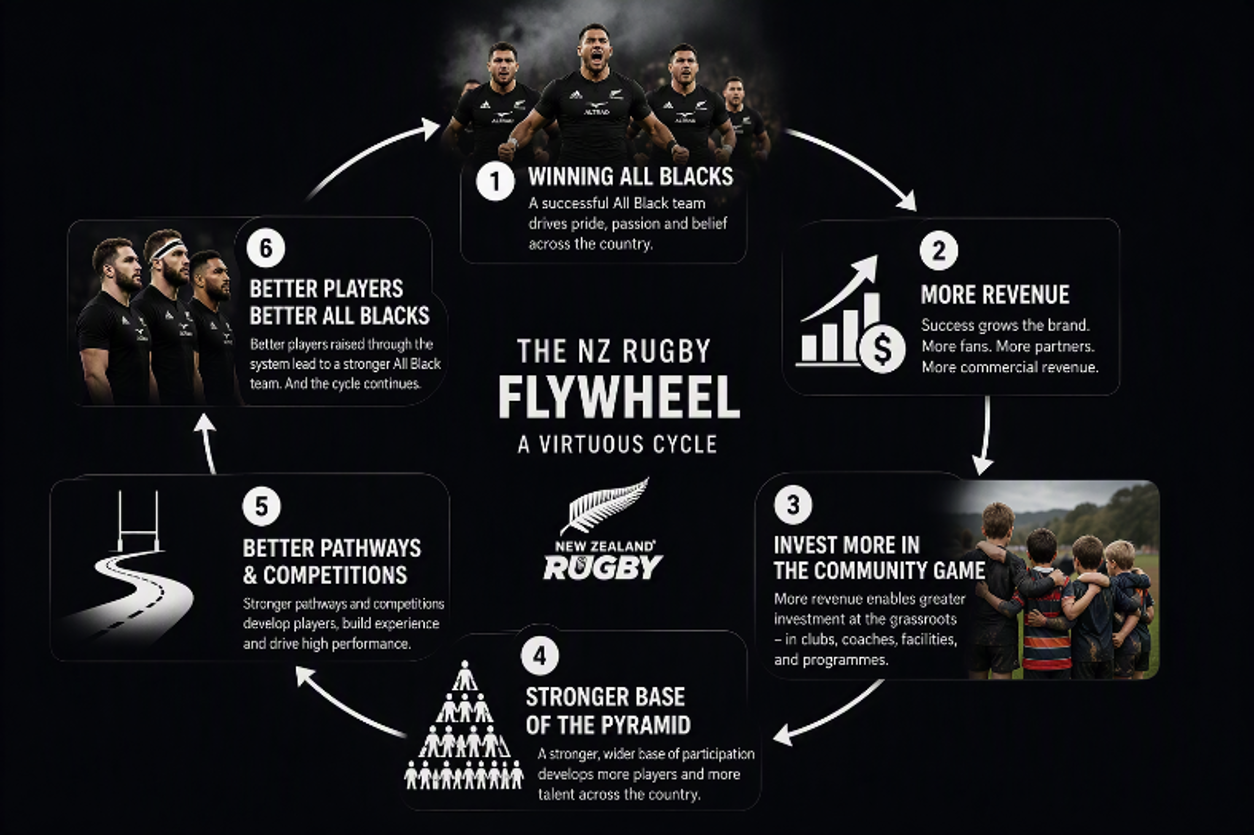
But in prioritising the All Blacks above all else, have we created the structural problem that now
requires the All Blacks to prop up the remainder of the game? It certainly seems so.
In a previous life, I organised, ran and developed rugby competitions for a living. The first question when designing any competition was always the same: what is its purpose? Is it to give a group of kids playing opportunities they would not otherwise experience? Is it to provide a pathway to identify and recognise the best? It could be almost anything, but a competition has to know why it exists.
Right now, what is Super Rugby’s purpose? Is it a vehicle for producing players for the All Blacks and Wallabies? Or is it a premier domestic competition, viewed as the pinnacle of rugby in the Southern Hemisphere? Can it genuinely be both?
Two legitimate models, one unresolved conflict
If Super Rugby is principally a development system for international rugby, the current settings make sense. Sabbaticals make sense. Mandatory All Blacks rest weeks make sense. Referees applying the game as though every match were a test makes sense, regardless of the effect on the entertainment product. New Zealand Rugby retaining majority control makes sense because it allows the national body to protect its players and prepare them for the international season.
But if Super Rugby is supposed to stand on its own as a premium competition, its interests should be secondary to nothing. The best players should play as often as possible in the toughest possible environments. Laws, interpretations and competition settings should produce an attractive, intelligible spectacle. Player welfare should be viewed through the prism of the Super Rugby season, rather than an eleven-month Super Rugby and All Blacks calendar. Private investment should be welcomed and given genuine freedom over payroll, appointments and the entertainment package. The ZURU Blues? Have at it.
Both models are legitimate. The problem is pretending they are the same model.
Can you achieve both in 2026? Probably not. There was a period when Super Rugby appeared capable of doing both. But that may have owed more to the strength of the teams, the novelty of the competition and the concentration of elite talent than to the coherence of its structure. Those conditions no longer exist.
Without serious change or a recalibration of purpose, New Zealand Rugby is still trying to do both. The result is that the flywheel is broken. We have prioritised the All Blacks and, in doing so, progressively weakened much of what sits beneath them. That creates even greater dependence on All Blacks revenue. It is a flywheel, but it is the wrong one.
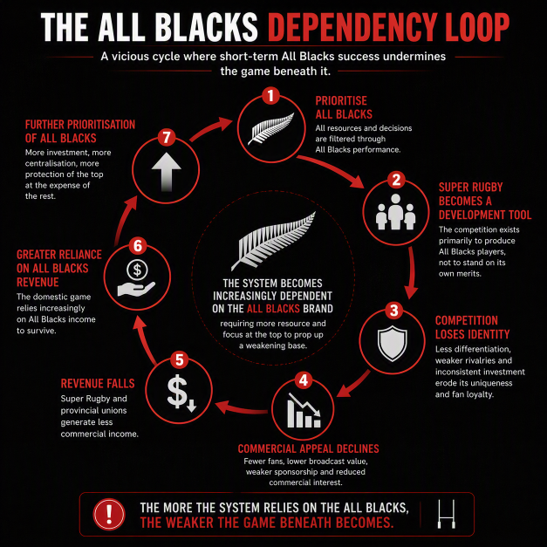
The dependency loop
Purpose before mechanics
Is there a successful sports competition anywhere in the world that openly serves competing purposes? The NRL knows it exists to be the best possible rugby league competition. France’s Top 14 behaves with similar clarity, sometimes to the frustration of the international game. Whatever their flaws, neither competition appears confused about which product comes first.
A lot of the commentary on New Zealand rugby quickly moves to what should be the second conversation: the mechanics required to achieve the chosen purpose. Ten teams or twelve teams. NPC, Super Rugby or some strange hybrid. Play-off formats. Kick-off times. All of that is secondary. First comes the purpose. Everything else follows.
For what it is worth, I think New Zealand Rugby has to break the professional structure down and start again. The current path is not sustainable. The domestic professional competition should become the primary week-to-week rugby product, with contracting, governance, investment, scheduling and player availability organised around that choice.
That may mean accepting less control. Private equity may hurt the All Blacks in the short term. Giving clubs or franchises greater freedom may create decisions that do not perfectly align with the next test window. But a stronger, more compelling domestic competition should build a larger audience, create more commercial value and better support the All Blacks in the long run.
Go the other way and New Zealand Rugby simply reinforces the dependency loop. Prioritising the domestic competition at some short-term cost to the All Blacks may be the only way to rebuild the flywheel for the long term.